Tackle/Ruck decision methodology
The following information was adapted from materials put together by Brad Cole, a Midwest Panel Referee from the Mid-South LRO.
Tackle Categories
Section titled “Tackle Categories”Tackles fall into four (4) categories:
- Positive Tackle - this is your standard tackle where the attacking team should maintain possession with a clean recycle and quick ball availability. These are by and large the most common type of tackle in rugby.
- Negative Tackle - this is where the defense has the upper hand and is usually driving the ball carrier back behind the gain line. Another way to think of it is a defensively dominating tackle. From a contextual point of view, the expected outcome of these would be a turnover.
- Neutral Tackle - this is a tackle that isn’t quite as dominating as the negative one, but not quite as open-and-shut for the attacking team. These are tackles where a fair contest for the ball occurs.
- Isolated Ball Carrier Tackle - this type of tackle is when a ball carrier has no support anywhere close to them and is brought down. Like a Negative Tackle, the expected outcome is a turnover by the defense due to a lack of supporting players.
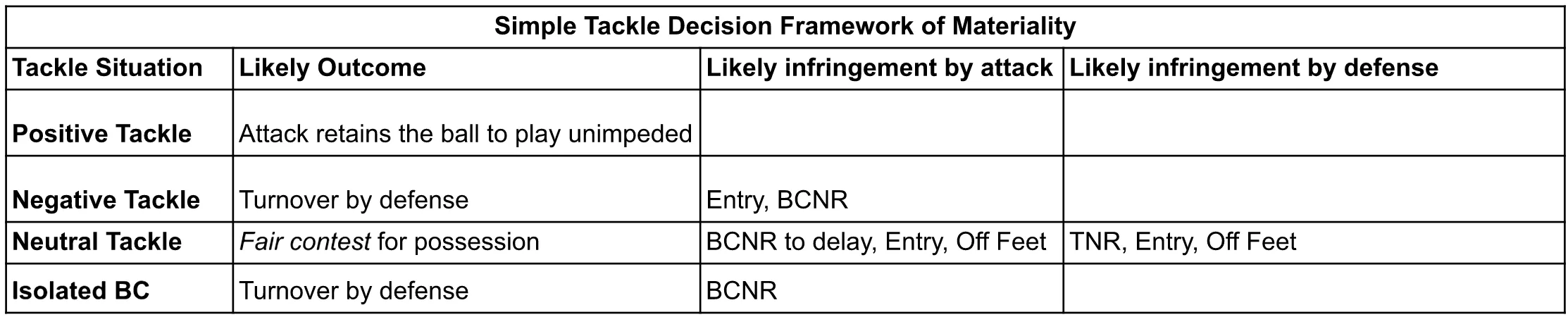
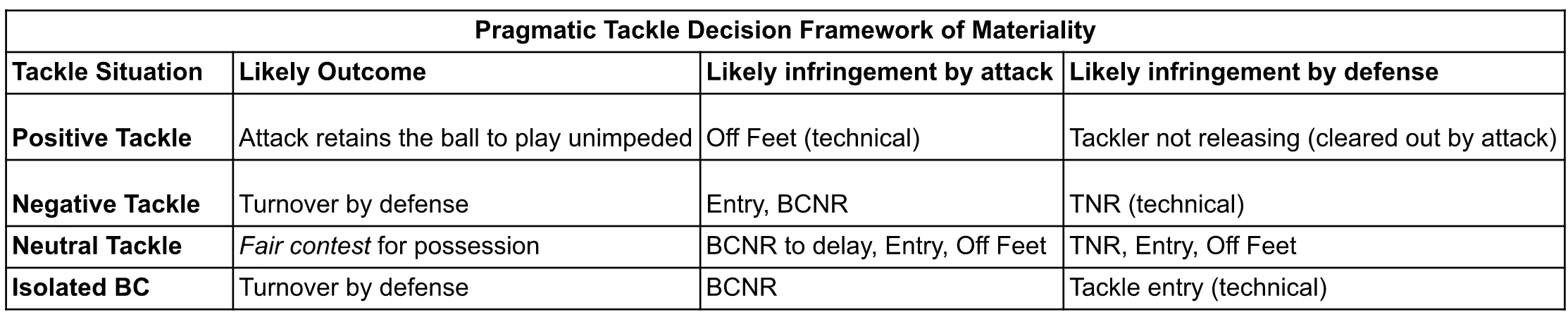
Due to the sprawl and complexity of the Tackle and Ruck laws and their application, a challenge is getting focused on what matters in a given situation. If we map likely offenses to the tackle categories above, it can lessen our mental load by filtering out infringements that are not applicable to the tackle type.
Pragmatic application
Section titled “Pragmatic application”A pragmatic version meant to be used intentionally (like when an opportunity to set a standard comes along).
Simple application
Section titled “Simple application”A simpler version meant to be used the majority of the time in a match.