

Triggers
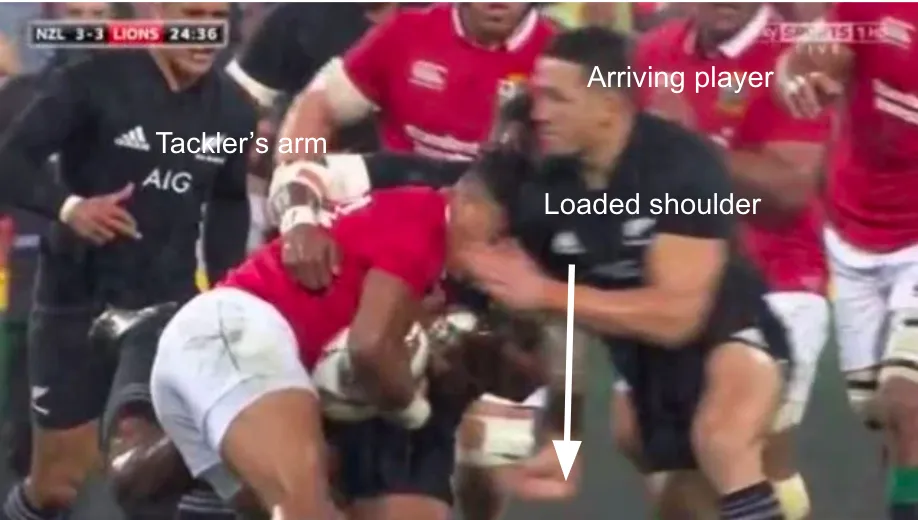
Pictures can tell a story. Now the visual triggers to prepare yourself as much as possible.

Below are resources for helping with process and application at the breakdown.
Advantage Rugby Referees has put together a very nice, comprehensive look at the breakdown.
Be aware of the context of the moment in the match.
Triggers
Pictures can tell a story. Now the visual triggers to prepare yourself as much as possible.
See Law 14.
For a tackle to occur, the ball-carrier is held and brought to ground by one or more opponents. Being brought to ground means that the ball-carrier is lying, sitting or has at least one knee on the ground or on another player who is on the ground. Being held means that a tackler must continue holding the ball-carrier until the ball-carrier is on the ground.
Ensure the tackler (and tackle-assist, when appropriate) release and roll away or don’t interfere with arriving players or the tackled player exercising their rights.
Tackled player must immediately make the ball available (placing or passing) and not prevent players on their feet from playing the ball.
Arriving players are entering the breakdown legally and safely while maintaining positive body positions/not leaving their feet.
Clean up the tackle will set you up for positive rucks. If the tackle is garbage, it will flow downhill and make the ruck garbage. Player frustration will mount and pressure will be put onto you as opposed to the players, where it belongs.
See Law 15.
For a ruck to occur, there must be one player from each side are in contact, on their feet, and over the ball.